Your Business
in Mind
Deeper Systems' primary mission is to provide practical solutions for real-world business problems using deep learning and machine learning solutions. We take a scientific approach to identifying and eliminating inefficiencies in ways most business owners do not know is possible.
Our experienced team will use our expertise to learn your business and provide custom technology so you can scale and grow. From workflow to data capture and organization, Deeper Systems can take you from static spreadsheets to dynamic technology that can run all aspects of your business.
AI Software
We build software from scratch or integrate into existing business environments, including tools that focus on delivering self-service capabilities, enabling decision-makers to recognize performance gaps. We also work on methods to help developers improve their efficiency in-house or as a service to clients.
Big Data
Does your business have hundreds of redundant, unlinked spreadsheets? We turn data into usable information with practical solutions.
Classification
Visual data can be used in non-intuitive ways to drive your business. We use images and computer vision to automate many expensive, time-consuming tasks.
Game Theory
Our team has a strong background producing game algorithms that outperform humans. We specialize in algorithms that exploit human weaknesses. In the end, business is practical game theory.
Case Studies
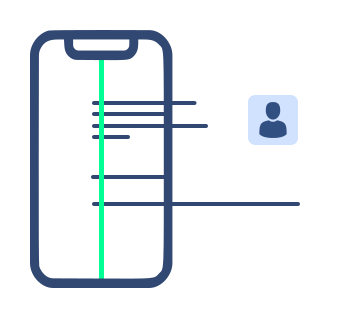
ID documents digitization
We used a neural network to identify document fields and their content, verifying and authenticating the data. The recognition of the ID pictures was also verified and matched with clients database to ensure validity of the documents.
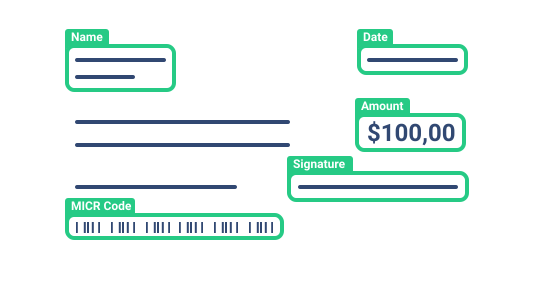
Bank cheque reader and classifier
Trained deep learning models to detect various fields of information on physical bank cheques. Then we processed that data using computer vision algorithms to get a perfect read of the number and letter characters. This technology served as a replacement of 95% of the work previously done by human hands at a much slower pace.
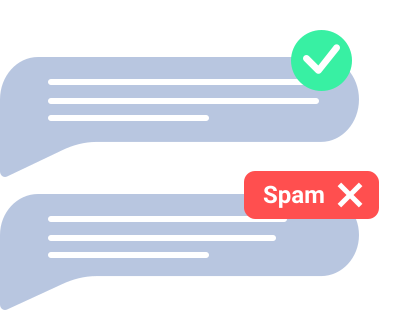
SMS verification
Inspecting big databases in mandarin we were able to filter and detect (with the help of deep learning models) text messages that contained spam, explicit content or specific keywords.
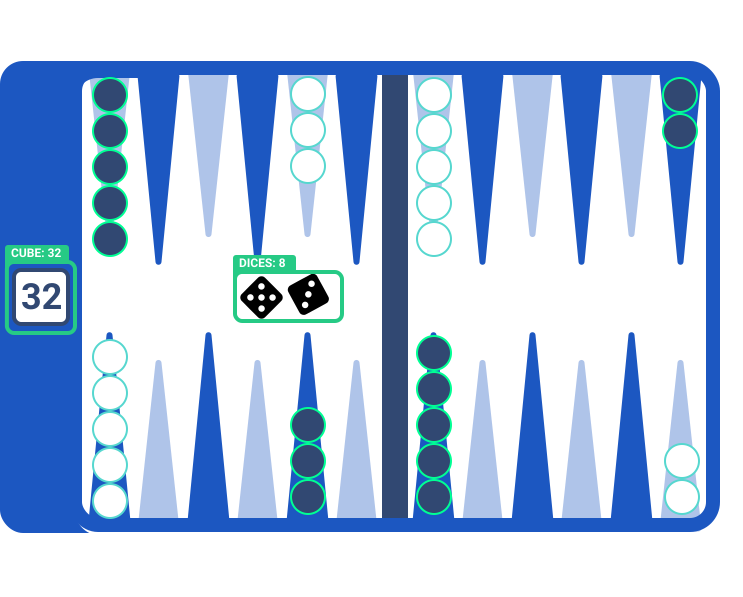
Backgammon technologies
We developed computer vision algorithms that detected all the components of a backgammon board and used it for live tournaments. Auto-detection of checkers position, dice rolls and players turns.
Medical Imaging
In some anesthetics it was necessary to use ultrasound and experienced doctors, in addition to causing pain in patients. This project contains the learning of the computer to guide the needle and perform the procedure.

Emotion Detection
Poker is a sport in which players are always trying to hide their true emotions. We are making headway into reading the poker faces of some of the best players in the world by magnifying small differences between frames.
Highlights

1st place, Conway's Reverse Game of Life 2020
The Process
Our approach was essentially to try as many things as possible and put our processing power on whatever the most promising one was at the time.
A key component was a small web service we built where our scripts could request a random individual to try, and then report their success or failure along with the algorithm name and the time it took to process. We then had a small webpage listing the algorithms and their performance in terms of score improvement per hour. This had several advantages:
- we could track how each algorithm did
- we could easily plug in new ones without needing to re-code timing and performance stats on each separate attempt
- it let us distribute the latest changes quickly to whatever available cores we had
Approaches
To put it in technical terms, we tried "a whole bunch of stuff". What we found is that certain approaches would work really well at the start and then get diminishing returns as they solved the 'easier' versions of the problems, or reached the limit of the approach. Thus we were constantly adding new approaches and rebalancing our power based on their continued performance. These are listed roughly in chronological order.